Rabu, 07 April 2010
Primate sperm competition: speed matters
Sperm cells from the sexually promiscuous chimpanzee and rhesus macaques swim faster and with greater force than those of gorillas. The surprise was how fast human sperm cells swim.

Selasa, 06 April 2010
Our Planet our Problem
 OUR PLANET, OUR PROBLEM: APPROACHES TO A CLIMATE SOLUTION FRIDAY, APRIL 9TH, 2010 CORWIN PAVILION, UNIVERSITY OF CALIFORNIA SANTA BARBARA
 This conference will bring influential members in the climate change arena to UCSB in order to provoke critical thought about the dilemma at hand. This full day event, featuring three panels addressing grassroots, business, and legislative solutions, respectively, comes in the wake of the UN Climate Conference in Copenhagen, Denmark. The event has been organized by students, and was conceived by a group of 23 undergraduates who were inspired to bring change to their campus community after attending the UN summit in December of 2009. By integrating grassroots, business, and government efforts, the event will empower the nation's youth to seek a greener future.
THE EVENT IS FREE AND OPEN TO THE PUBLIC
Sponsored by the Associated Students Environmental Affairs Board, UCSB Environmental Studies Program, the College of Letters & Sciences Critical Issues in America series, the Institute for Energy Efficiency, Campus Progress / Center for American Progress, the League of Women Voters of Santa Barbara, the Community Environmental Council, Office of the Chancellor, Office of the Vice Chancellor for Student Affairs, Collegiate Panhellenic Council, Office of the External Vice President for Local Affairs, and the Green Campus Program
10:00AM - 12:00PM
Global Climate, Local Change
Corwin Pavilion
Presenter/Speaker Info
Dave Davis, CEO & Executive Director, Community Environmental Council
Jason Mark, Author, Building the Green Economy: Success Stories from the Grassroots; Director, Alemany Farm
Kandi Mosset, Tribal Campus Organizer, Indigenous Environmental Network
Alec Loorz, Founder, Kids vs. Global Warming
Moderator: Natasha Joyce Weidner, Sustainable Foods Chair, Environmental Affairs Board
Panel Description
This panel will demonstrate the power of individuals to tackle climate issues in their communities at the grassroots level. Unique approaches on a local level are a crucial element to achieving a climate solution. The passionate work of average citizens around the United States continues to build even when the government and business fail to act. We invite members of the Santa Barbara community to come learn what is being done now to reduce our climate impact.
Refreshments served
12:00 - 1:30 PM
Student Film Screening: Navigating Copenhagen
Corwin Pavilion
Movie Description: 23 UCSB students attended the 2009 United Nations Climate Conference in Copenhagen, Denmark. This film catalogues their experiences and perspectives on the international deliberations as well as the grassroots activism outside of the official conference.
Presenter/Speaker Info
Filmmakers
Students from UCSB Copenhagen delegation
Moderator: Corie Radka, External Affairs Chair, Environmental Affairs Board
1:30 - 3:30 PM
The Green Economy: Moving Beyond Business as Usual
Corwin Pavilion
Presenter/Speaker Info
Jim Dehlsen, Founder & Chairman, Clipper Windpower
Brent Constantz, CEO, Calera Corp.
John Fielder, President, Southern California Edison
Moderator: David Auston, Associate Director, Institute for Energy Efficiency
Panel Description
This panel will highlight the integral role of business innovation in reconciling society and climate. For global capitalism to function properly in the 21st century, new solutions must take hold that minimize our impact on the environment. Science, technology, and industry are mobilizing to advance a new, green economy. It will take forward-thinking ideas to reshape society, create jobs, and usher in a new era of sustainability.
4:00 PM - 6:00 PM
The Power of Politics: Legislative Measures that Work
Corwin Pavilion
Presenter/Speaker Info
Fran Pavley, California State Senator
Mary Nichols, CA Air Resources Board Chairman
Moderator: Robert Wilkinson, Professor, Environmental Studies
Panel Description
This panel will explore legislative solutions to climate change at the international, domestic, and sub-national levels, with particular emphasis on measures that work. Panelists will address the audience with a focus on solutions, and will speak to the potential of youth and activists to effect change in the policy arena.
6:00 PM - 7:00 PM
Reception in the MultiCultural Center
Senin, 05 April 2010
Bigger testes and semen displacement
 A paper in PLoS One last month: Genetic Patterns of Paternity and Testes Size in Mammals
Also the subject of a news article in National Geographic: Bigger Testes Can Offer a Competitive Edge
When competition for females is fierce, males of some species have evolved bigger testes to trounce their rivals, a new study has confirmed.
Specifically, the research shows that testicle size matters in highly competitive animal societies in which females mate with many males or in which females live in groups ruled by an alpha male that must constantly defend his harem.
But that doesn't mean that females seek out more endowed males. Rather, the rivalry occurs after mating, as sperm battle inside the female.
Not surprisingly, males with larger testes produce more sperm—giving the male, so to speak, more bang for his buck.
Just how much all this applies to humans is always interesting to consider. Here's a curious paper with a lot more speculation than data: Semen Displacement as a Sperm Competition Strategy in HumansWe examine some of the implications of the possibility that the human penis may have evolved to compete with sperm from other males by displacing rival semen from the cervical end of the vagina prior to ejaculation. The semen displacement hypothesis integrates considerable information about genital morphology and human reproductive behavior, and can be used to generate a number of interesting predictions.
Human Gene Patents Invalidated
Basing his decision on legal arguments that human genes are products of nature and hence cannot be patented, in March of 2010 a U.S. District Court judge invalidated several patents held by a company called Myriad Genetics on the human breast cancer genes, BRCA1 and BRCA2. Myriad Genetics sells a kit used to test for the two genes for about $3,000. The company tried to argue that their method of isolating the genes changed the genes, and thus made them patentable. But the judge ruled that such an argument was just a trick to circumvent the prohibition on the direct patenting of DNA.
About 20% of human genes have already been patented. A number of biotech companies were planning to make a hefty profit by developing and selling patent-protected genetic tests or by selling the patent rights to others. Whether all of those patents could ultimately be invalidated is unclear. With potentially billions of dollars at stake, the decision is likely to be appealed.
Medical and research organizations and patients are pleased by the decision. If it holds up on appeal it should provide wider access to human genes currently under patent protection, and ultimately make genetic tests like those for BRCA1 and BRCA2 less expensive.
About 20% of human genes have already been patented. A number of biotech companies were planning to make a hefty profit by developing and selling patent-protected genetic tests or by selling the patent rights to others. Whether all of those patents could ultimately be invalidated is unclear. With potentially billions of dollars at stake, the decision is likely to be appealed.
Medical and research organizations and patients are pleased by the decision. If it holds up on appeal it should provide wider access to human genes currently under patent protection, and ultimately make genetic tests like those for BRCA1 and BRCA2 less expensive.
Sabtu, 03 April 2010
Something for the weekend
 I briefly mentioned some of the work of University of Manchester researchers Robin Baker and Mark Bellis. Their work on sperm competition in humans has attracted quite a number of popular articles.
Here's one from New Scientist: The subtle side of sex and one from the somewhat dubiously entitled seductionlabs.org: Sperm competition and the Kamikaze Sperm Hypothesis.
Both are well written and interesting articles with the latter article from 2007 being a little more critical of the kamikaze sperm hypothesis in humans than the earlier 1993 article.
Kamis, 01 April 2010
I googled dragonfly penis so you don't have to....
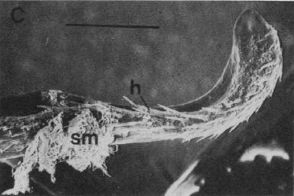 There are numerous articles on this topic (people love to read about freaky animal sex). National Geographic's is pretty good but, sadly, does not include any pictures of the 'rigid, spoonlike, and sometimes spiky' penis. The picture to the left is from Jonathan Waage's seminal (pun intended) paper Dual Function of the Damselfly Penis: Sperm Removal and Transfer
Grab, shake, bite, gouge, puncture, split, punch: It's enough to put anyone off sex.
In a brilliant experiment some years ago, Jonathan Waage of Brown University discovered the Rosetta stone to this strange mating behavior. Waage studied the jewelwing damselfly Calopteryx maculata. First he examined the sperm-storage organ of females after a couple of matings to determine whether sperm from a second mating was added to sperm from the first. He was surprised to find that the amount of sperm hadn't changed. Then he dissected pairs in the midst of copulation and studied their sex organs under an electron microscope. The experiment revealed that a male dragonfly uses his penis not just to transfer sperm to the female, but also to remove sperm left in her storage organ from previous matings. When he curls into that wheel position and begins his energetic genital thrusting, he's actually using his rigid, spoonlike, and sometimes spiky, penis to scrape out rival sperm before he deposits his own.
Such a ploy is necessary, Corbet says, because of female choice and sperm competition. A female nearly always mates with more than one male; it's in her interest to "upgrade" her fertilizations if she can, thereby exercising choice over the paternity of her offspring. Males want their sperm alone to prevail, so they have evolved strategies for purging other sperm and for discouraging mates from copulating with rivals. In this game of sexual chess, the last sperm into the female's storage organ wins by fertilizing her eggs.
DNA Mutations Between Generations
How often do errors in DNA replication occur between generations – i.e., how many times are new mutations found in a child that were not present in a parent? These new mutations created between generations would represent a “human mutation rate”. Undoubtedly they would contribute to human evolutionary change.
The human mutation rate per generation has been difficult to measure, but several different laboratories have now come up with numbers that are remarkably similar. According to the most recent estimate, the answer is about 60 DNA nucleotide base errors per generation. That sounds like a lot, but given that there are 3 billion nucleotide base pairs (6 billion bases) in the DNA in a human cell, that’s just one error in every 100 million bases. DNA replication and repair mechanisms are remarkably accurate, it seems.
And that’s why human evolution has occurred so slowly, over several million years.
The human mutation rate per generation has been difficult to measure, but several different laboratories have now come up with numbers that are remarkably similar. According to the most recent estimate, the answer is about 60 DNA nucleotide base errors per generation. That sounds like a lot, but given that there are 3 billion nucleotide base pairs (6 billion bases) in the DNA in a human cell, that’s just one error in every 100 million bases. DNA replication and repair mechanisms are remarkably accurate, it seems.
And that’s why human evolution has occurred so slowly, over several million years.
Langganan:
Postingan (Atom)