Selasa, 12 Januari 2010

Epigenetics

I've always tried to be fair to Lamark when I teach - after all he did get much right. It now turns out that even his mechanism may work in some situations.

In the last few years the exploding field of epigenetics has finally provided the mechanism by which acquired characteristics can be passed on to offspring. (Epigenetics is the study of how gene expression is altered by mechanisms other than changes in the underlying DNA sequence.)

Here's one very readable introduction to the topic: Two new studies show that the effects of a mother's early environment can be passed on to the next generation.
or a more in depth paper on bacterial epigenetics:
Epigenetic Gene Regulation in the Bacterial World

UCSB has a number of researchers working on epigenetics and a number of courses you can take if this is of interest to you. Professor David Low of MCDB, one of the authors of the above paper, works in this area and has just agreed to become a CCS advisor. He has had very positive interactions with CCS students in his lab and hopefully this will continue.

Chosen topics

What is this topic of which we speak? Since choosing a topic to investigate each week is an important part of the assessment for this class I thought I'd post some suggestions from the first few classes.

In no particular order here are ten topics that come to mind (this is by no means a comprehensive list):
  • Giraffe neck evolution. What is the full story?
  • Have recent advances in epigenetics provided a mechanism for the inheritance of acquired characteristics proposed by Lamark (see next blog post above).
  • Whatever happened to that Big Bird chicken?
  • Tiktaalik - the 'fishopod'. Is it a 'missing link'? What do we mean by that? Is there a better term?
  • When we directly compare the DNA between species how do we do this given that there is variation within a species?
  • How old do we now think the earth is? How do we know this? Could we be wrong?
  • What is the likelihood we will find evidence of an alternate origin of life? Has anyone claimed we already have?
  • How do you go about looking for 'weird life'?
  • What IS life? Any interesting recent musings on this topic. If you really want to go there?
  • Virophages. The virus parasite I briefly mentioned.

Senin, 11 Januari 2010

New techniques for sequencing

I mentioned that genetic sequencing is now one of the important tools used in systematics. However up until now this has been problematic when working with early human specimens, or close relatives. This is because the technique involved multiplying up small fragments of DNA and so even a tiny amount of contamination from a modern human (eg an archaeologist who handled the bones) could become a huge problem if this contaminant were multiplied.

'Using the remains of humans that lived in Russia about 30,000 years ago, Svante Pääbo and his colleagues now make use of the latest DNA sequencing (i.e., reading the sequence of bases that make up the DNA strands) techniques to overcome this problem. These techniques, known as "second-generation sequencing," enable the researchers to "read" directly from ancient DNA molecules, without having to use probes to multiply the DNA. Moreover, they can read from very short sequence fragments that are typical of DNA ancient remains because over time the DNA strands tend to break up. By contrast, DNA that is younger and only recently came in contact with the sample would consist of much longer fragments. This and other features, such as the chemical damage incurred by ancient as opposed to modern DNA, effectively enabled the researchers to distinguish between genuine ancient DNA molecules and modern contamination. "We can now do what I thought was impossible just a year ago -- determine reliable DNA sequences from modern humans -- but this is still possible only from very well-preserved specimens," says Pääbo.'

The paper is in the Jan 12 edition of Current Biology and there's a more popular write up on the ScienceDaily website.

Minggu, 10 Januari 2010

What are you reading?

Here's an easy way to get posting.

What are you reading? What are your favorite science related websites? The ones that you visit on a semi-regular basis. Add a new posting or post a reply to this one. Here's a few of my favorites:
  • ScienceDaily - hard to beat for keeping on top of a wide variety of biology. I wish they'd link to the actual articles they summarize, instead of giving you a few clues to track them down, but apart from that it's a great site and not a bad one to use as your homepage.
  • Science of Sport -a little hard to describe but it's a bit like a Freakonomics approach to sport. For a subject that has been obsessed with statistics for many years it is surprising how rarely sport has been analyzed scientifically. They tend to focus on athletic events such as running, swimming and cycling rather than team sports but they don't seem to have any particular rules and plenty of odd subjects crop up.
  • Pharyngula - Evolution, development, and random biological ejaculations from a godless liberal. How words not mine. The author, PZ Meyers is a biology professor at the University of Minnesota. He'll actually be speaking on campus on 'Complexity and Creationism' on January 20th if you are interested.
What do you read?

Sabtu, 09 Januari 2010

What's in a name?

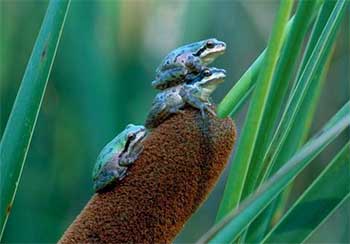
I know that some of you probably live in Manzanita Village. If so, or if you have been out near a pond after dark lately, you have probably heard the deafening sound of frogs. The loudest local spots I've noticed are the pond between Manzanita Village and the lagoon and, a little later in the year, the wet area between Storke road and the golf course.

We don't have any tree frogs in England so when I came to California I was amazed to find out that all the noise is made by these little guys, Pseudacris regilla - often not much bigger than an inch.

For a little frog they also have a lot of names - at least two common names: the Pacific tree frog, and the Pacific Chorus frog and lots of people just call them Hyla because they used to be called Hyla regilla. Until 2005 Hyla was a large genus of frogs with over 300 species. However a systematic review of the genus Hyla in 2005 split the genus into three new genera: Aris, Limnaoedus, and Pseudacris (why do you think they did this?), requiring the renaming of all 300 plus species.

Although the revision better reflects our understanding of the evolution of these frogs it's unfortunate that this involves renaming all the frogs and the loss of some familiar names. The frogs haven't changed just our understanding of their evolution.

Jumat, 08 Januari 2010

Alternative titles

It's a little fast and hard to keep up with in places, especially in the latter stages but the fast moving style, pop culture references and connections to Thursday's class make this video well worth a look. Eddie Izzard suggests some of the rejected titles for Darwin's big book....

Kamis, 07 Januari 2010

Bypassing the constitution

You may have heard the saying 'Science progresses by the death of scientists.' Several people have said something like this, perhaps the most famous being Max Planck the German theoretical physicist and generally accepted as the founder of the quantum theory in physics.

“A new scientific truth does not triumph by convincing its opponents and making them see the light, but rather because its opponents eventually die, and a new generation grows up that is familiar with it.”

Creating a taxonomy that reflects evolutionary history is now firmly established in biology and the the techniques of cladistics are used to classify organisms into hierarchical taxonomic groups. None of this is very controversial, at least not any more.

However the question of whether we should continue with the Linnean taxonomic code or adopt something different is a very hot topic. I suspect that this is one of those changes that is going to take the death of a generation of biologists to change. There was a good article about the issue in American Scientist in 2006: Attacks on Taxonomy.

Unlike the PhyloCode, Linnean taxonomy does not formally incorporate phylogeny. However, its ranks (species within genus, genus within family, family within class and so on) imply evolutionary relationships. The main drawback of the Linnean system is that groups must be named with suffixes that denote their rank in this hierarchy. For instance, all animal families end in -ae, as in Hominidae. Reclassification of an existing species or discovery of new one can lead to changes in rank and therefore require renaming whole suites of taxonomic groups—a cascade of renaming—even without any new information on those groups. The Phylo-Code solves this problem.

Discover magazine also had a nice article that focused a little more on the people and the controversy: Pushing Phylocode.

“This would be very similar to a set of politicians who decided to bypass the Constitution to create a whole new set of laws.”
 
Copyright 2010 Biology Blog Education. All rights reserved.
Themes by Ex Templates Blogger Templates l Home Recordings l Studio Rekaman